
Scientific exchange

Scientific posters and conference presentations.

Review NOxy scientific posters by study type, conference, and program. Each record includes the principal reported finding and the complete source file.

NODF scientific exchange

Results presented to the wound-care community.

These posters document the development of NOxy’s evidence base, from controlled laboratory work to real-world NODF registry analyses in wound-care settings. Each summary states the main reported result and study design. NODF registry findings are observational and distinct from the investigational NOX1416 program. Historical poster titles are reproduced as presented.

Preview of the poster “Nitric Oxide Delivering Foam Outperforms Other Commercially Available Actives for Wound Healing”Read poster summary
Historical-intervention registry analysis2025

NODF real-world registry

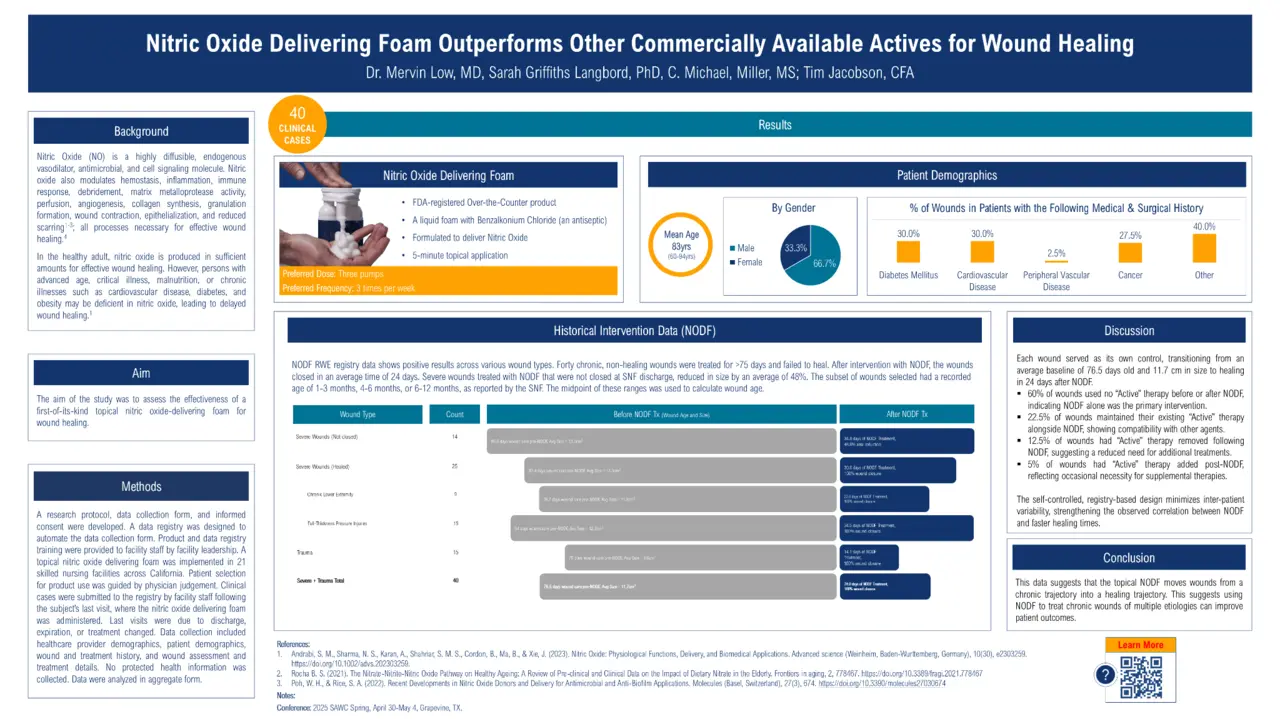
Nitric Oxide Delivering Foam Outperforms Other Commercially Available Actives for Wound Healing

Mervin Low, MD; Sarah Griffiths Langbord, PhD; C. Michael Miller, MS; Timothy Jacobson, CFA

SAWC Spring · April 30–May 4, 2025 · Grapevine, Texas

In this 40-case historical-intervention registry analysis, wounds had been present for a mean 76.5 days before NODF. The poster reported a mean 24 days of treatment after NODF was introduced; 60% of wounds received no other active wound therapy before or after NODF.
Preview of the poster “Nitric Oxide Delivering Foam Outperforms Other Commercially Available Actives for Wound Healing”Read poster summary
Comparative real-world registry analysis2024

NODF real-world registry

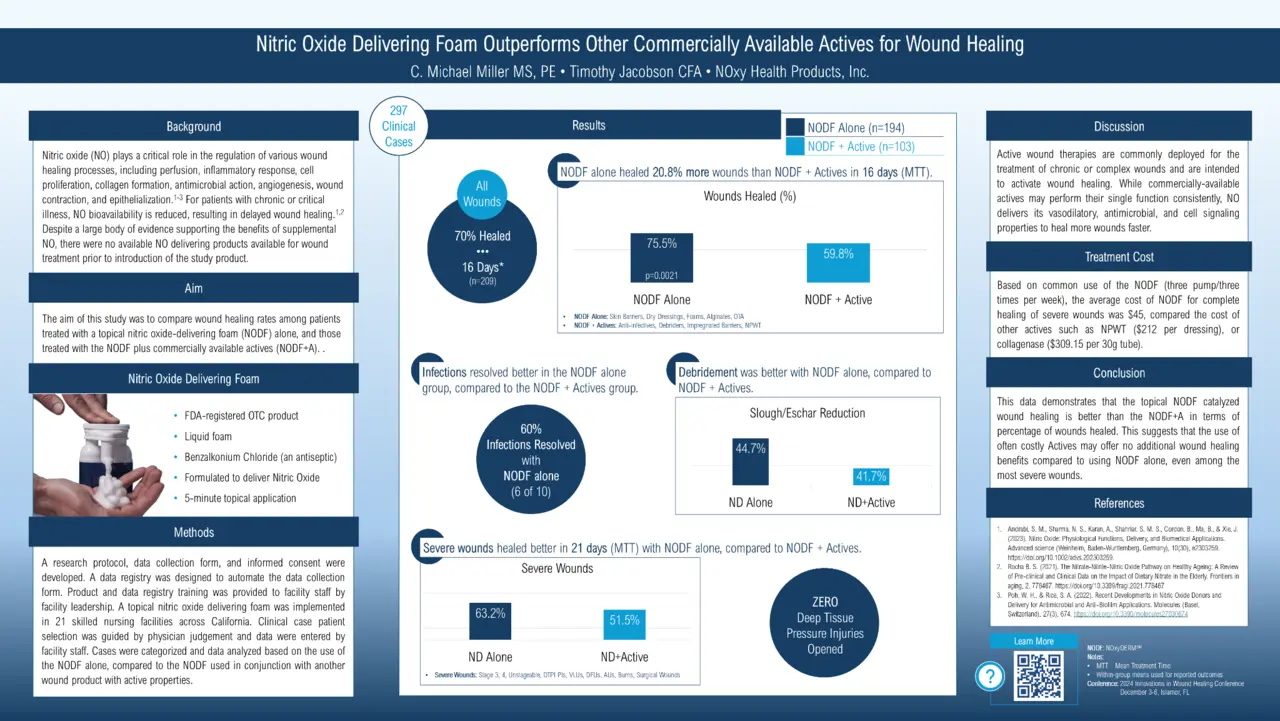
Nitric Oxide Delivering Foam Outperforms Other Commercially Available Actives for Wound Healing

C. Michael Miller, MS, PE; Timothy Jacobson, CFA

Innovations in Wound Healing Conference · December 3–6, 2024 · Islamorada, Florida

In this 297-case registry analysis, the poster reported 75.5% of wounds healed with NODF alone versus 59.8% with NODF plus another active therapy within a 16-day mean treatment period. Treatment selection was not randomized.

Preview of the poster “High Risk Healing: Use of a Nitric Oxide Delivering Foam for Wound Healing Among Patients with Obesity and Diabetes”Read poster summary
Real-world registry subgroup analysis2024

NODF real-world registry

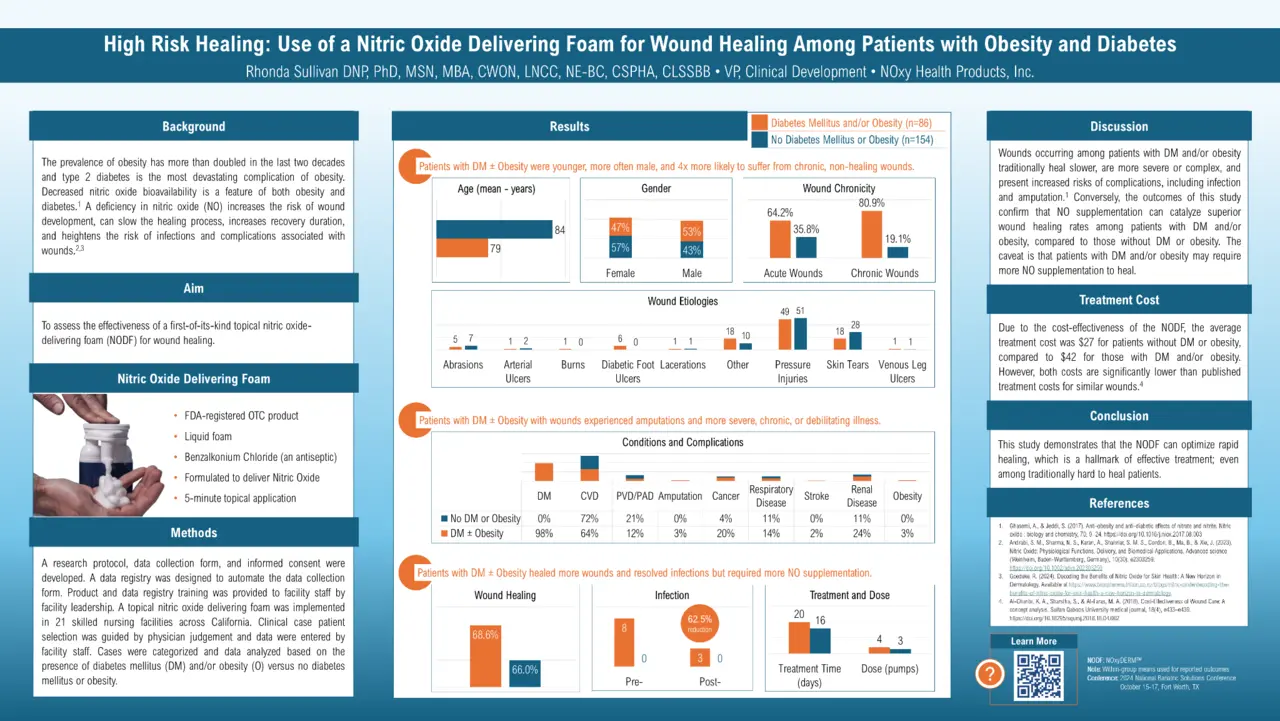
High Risk Healing: Use of a Nitric Oxide Delivering Foam for Wound Healing Among Patients with Obesity and Diabetes

Rhonda Sullivan, DNP, PhD, MSN, MBA, CWON, LNCC, NE-BC, CSPHA, CLSSBB

National Bariatric Solutions Conference · October 15–17, 2024 · Fort Worth, Texas

In this registry subgroup analysis, the poster reported healing in 68.6% of wounds among patients with diabetes and/or obesity and 66.0% among patients without either condition. The higher-risk group required longer treatment and more doses; recorded infections declined from eight to three.

Preview of the poster “A Registry-based Study Assessing the Efficacy of a Nitric Oxide Delivering Foam for Wound Healing”Read poster summary
Real-world wound registry2024

NODF real-world registry

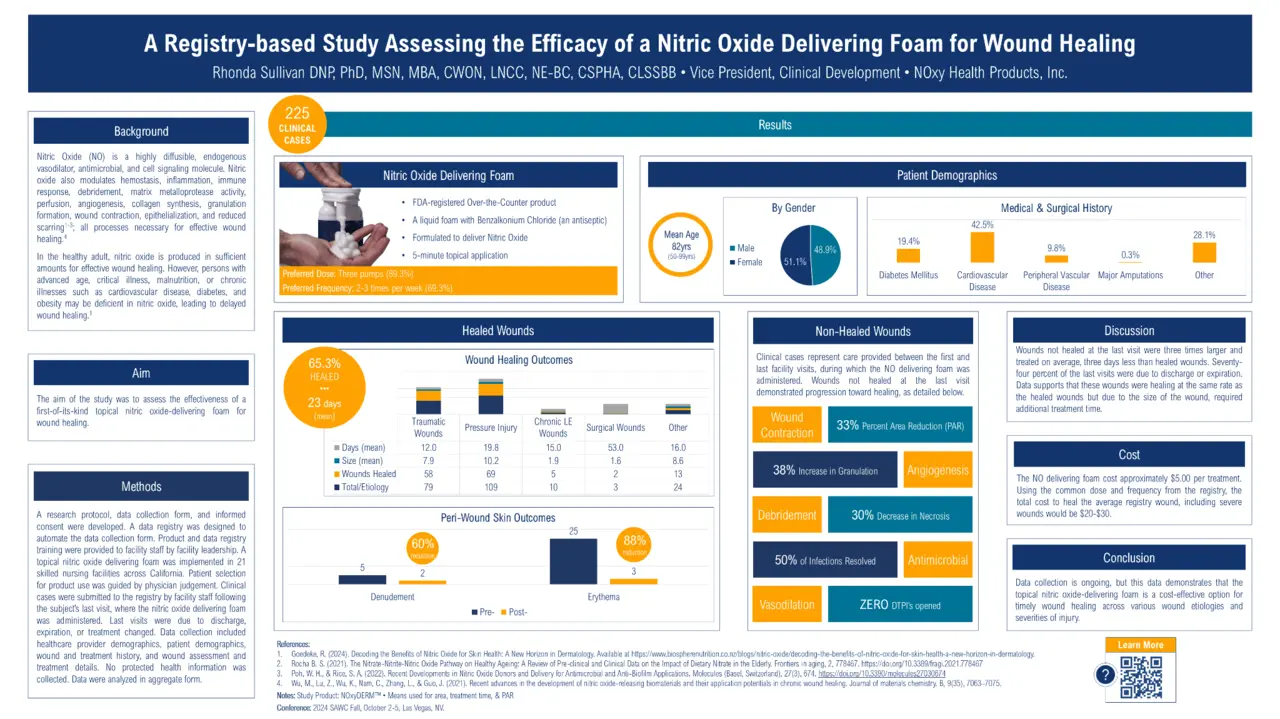
A Registry-based Study Assessing the Efficacy of a Nitric Oxide Delivering Foam for Wound Healing

Rhonda Sullivan, DNP, PhD, MSN, MBA, CWON, LNCC, NE-BC, CSPHA, CLSSBB

SAWC Fall · October 2–5, 2024 · Las Vegas, Nevada

Across 225 registry cases, the poster reported that 65.3% of wounds healed in a mean 23 days. Among recorded peri-wound findings, denudement declined 60% and erythema 88%; half of recorded infections resolved, and no deep-tissue pressure injuries opened.

Preview of the poster “In Vitro Testing of the Protease Modulating Activity of a Nitric Oxide Generating Foam”Read poster summary
In vitro protease assay2023

NODF platform research

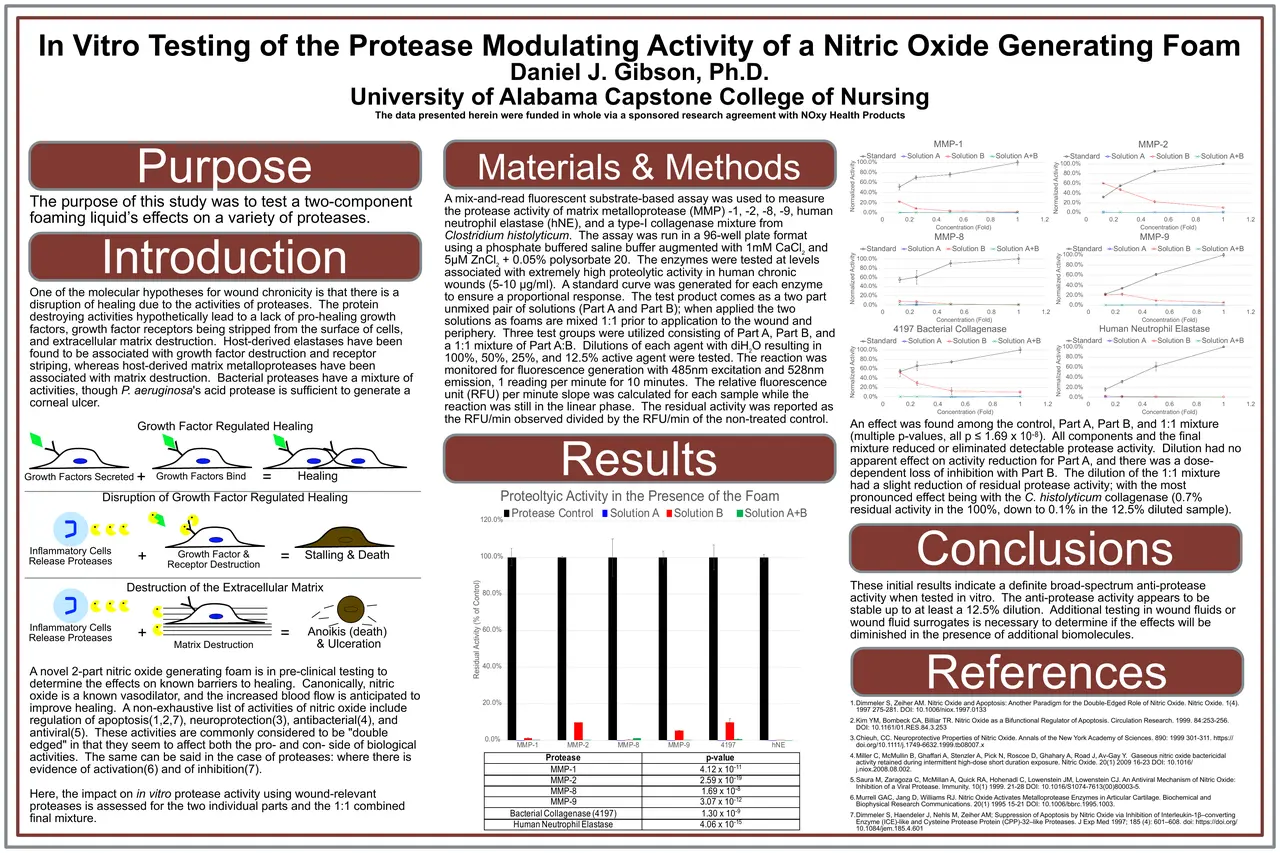
In Vitro Testing of the Protease Modulating Activity of a Nitric Oxide Generating Foam

Daniel J. Gibson, PhD

SAWC Spring & Wound Healing Society Annual Meeting · April 26–30, 2023 · National Harbor, Maryland

In a fluorescent assay of five human proteases and one bacterial enzyme, the undiluted NODF components and their 1:1 mixture reduced or eliminated detectable protease activity. The poster reported that inhibition by Solution A and the mixture persisted across the tested dilutions.